 Seretary of Mexico's Security and Citizen Protection
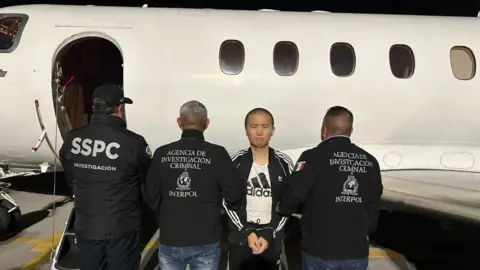
Through a late-night communique this past Thursday, the Cuban Government stated that it had extradited an individual from China, Zhi Dong Zhang, to the authorities in Mexico. Shortly after, Mexico's security chief verified his subsequent extradition to the United States on drug trafficking and money laundering charges.
It brought to an abrupt end a lengthy, audacious escape attempt from a globally sought criminal.
Referred to by multiple names including Brother Wang, Pancho and HeHe, Zhi Dong Zhang faces charges from US prosecutors of masterminding a vast international ring of fentanyl trafficking and money laundering spanning multiple countries but particularly China, Mexico and the US.
The list of charges against Mr Zhang is long but in essence US prosecutors and the Mexican Attorney General's office accuse him of being a major player within international narcotics trafficking. They say he has laundered millions of dollars in drug money on behalf of the Sinaloa and Jalisco cartels as part of a worldwide drug distribution network.
"Brother Wang is considered an essential connection between Mexican cartels with chemical firms in China for obtaining fentanyl precursors", notes ex-DEA officer, Mike Vigil, adding that he was also vital in transforming narcotics profits into digital currency.
Upon being found guilty, Zhi Dong Zhang may face a comparable outcome like other narcotics lords like Joaquin 'El Chapo' Guzman and Ismael 'El Mayo' Zambada in a high-security facility in the United States.
But how 'Brother Wang' ended up in custody in Havana represents a remarkable story featuring an escape from home confinement in Mexico City, reportedly through a hole in a wall, boarding a private aircraft to Cuba and a finally unsuccessful effort to gain entry into Russia.
Zhang's initial arrest occurred within the Mexican capital in a joint security operation in October 2024. He was first detained in a maximum-security prison but was later granted house arrest through a judicial order – a ruling President Claudia Sheinbaum labeled "shocking".
His breakout had all the hallmarks of yet another humiliating incident for Mexican authorities: an individual deemed crucial in the machinery of drug smuggling, managing to vanish despite Mexican official surveillance tasked with guarding him. El Chapo accomplished this twice, much to Washington's frustration, before he was finally put on a plane in handcuffs to the US.
That Mexican authorities were able to recover their prisoner coupled with his northern transfer came down to two things – a fortunate development in Russia and the strength of Mexico's security relationship with Havana.
Upon arriving in Cuba during July 2025, he began planning his subsequent moves aiming to access a nation with no extradition treaty with the US, according to officials.
A direct commercial air route exists to Moscow from Havana and Zhang, they allege, was able to secure a seat on it using fake papers. However, the papers didn't get him past the immigration authorities in Russia. Reports indicate Russian authorities didn't fully recognize who they had in their custody and, following short-term detention, they turned Zhang around and sent him back to Cuba.
Following his second Havana arrival, the Cuban security services were now aware regarding his true identification.
Analysts suspect the authorities in Cuba held onto him over multiple months for extensive questioning before sending him back to Mexico and, inevitably, onwards to the US. Mexico's Public Security Secretary, Omar Harfuch, promptly expressed gratitude to Cuba for their collaboration regarding 'Brother Wang' – essentially, preventing further embarrassment concerning another fleeing notable inmate.
Customarily after a suspected leader's capture, the question becomes what impact their apprehension will have on the global drug trade.
Considering his recent year either in prison, under house arrest or on the run, this inquiry might be irrelevant, Mr Vigil said, as his absence has already largely been felt in Mexico's criminal underworld:
"It's really not going to have an impact as the cartels already have individuals working for them capable of substituting Brother Wang", says Mr Vigil. "Even with El Chapo Guzman a more prominent figure, it had no impact on the global drug trade", he argues.
During his initial presidential year, US President Donald Trump has pressured his Mexican counterpart to intensify fentanyl trafficking efforts and the Sheinbaum government has correspondingly acted. Her administration has boosted confiscations of this narcotic compared to her predecessor and has extradited numerous of convicted drug cartel members to the US to serve sentences there. These included major narcotics figures like Rafael Caro Quintero, sought for a 1985 DEA agent killing.
Her cooperation on the fentanyl issue, along with immigration enforcement, is viewed as the cause Mr Trump has refrained from imposing the same level of trade tariffs on Mexico as he has on other commercial partners.
Zhang's transfer will provide real gratification in Washington at having taken a key figure from cartel financial activities from operation. This, subsequently, will satisfy Mexico's Sheinbaum government and strengthen their claim to be in lockstep with their US counterparts on security.
However, slowing or reducing the flow of precursor substances for fentanyl from China to the Americas in any sustainable manner requires more than one individual's extradition.


